
History

To understand how Toki NGO was born, we go back to 1992, when an eight-year-old girl named Mahani Teave left Rapa Nui with her mother and sister to study piano in Valdivia (South of Chile).
Leaving Rapa Nui was the only possible path if she wished to become a classical pianist, since there were no pianos or trained teachers on the island at that time.
After years of study and training in mainland Chile, the United States, and Germany, her discipline and determination yielded results: she became one of the most prominent pianists in the history of Rapa Nui and earned recognition on the world stage.
Still, she always dreamed of returning to her island to help other children who, like her, loved music but had no place or tools to develop their talent.
In 2008, Mahani gave an interview explaining that there was still no piano on the island. Sixteen years later, nothing had changed. Her testimony drew the attention of philanthropists Lily Urdinola and Lily Lanz who, together with Mahani’s then-representative, Manuel Ahumada, managed—during one of Mahani’s tours and with the support of renowned pianist Roberto Bravo—to secure the donation of the first two pianos for the island through Fundación Itaú. Later, support from the former National Council for Culture and the Arts and the Rapa Nui Cultural Corporation made it possible to bring the island’s first piano teacher, marking the beginning of formal piano lessons in Rapa Nui in 2012.
In parallel, Mahani and a diverse group of young rapa nui united around several urgent challenges for the island: music education, the protection of ancestral heritage, social uplift, and environmental preservation.
This group of young people had left the island at ages 17–18 to pursue university studies and professional training. Now, they wished to return their knowledge and vision to Rapa Nui, creating opportunities and driving change from civil society.
In 2013, they came together to found Toki Rapa Nui NGO. The organization’s first concrete action was taking under its wing the piano and violin classes —the latter having recently been added. These early courses soon became the foundation for what would grow into the School of Music and the Arts.
Over time, the emerging school incorporated cello and ukulele classes as well. And although the project continued to expand, it could not yet reach its full potential: there was still no dedicated space capable of bringing all disciplines together. Classes continued to take place in borrowed community venues.


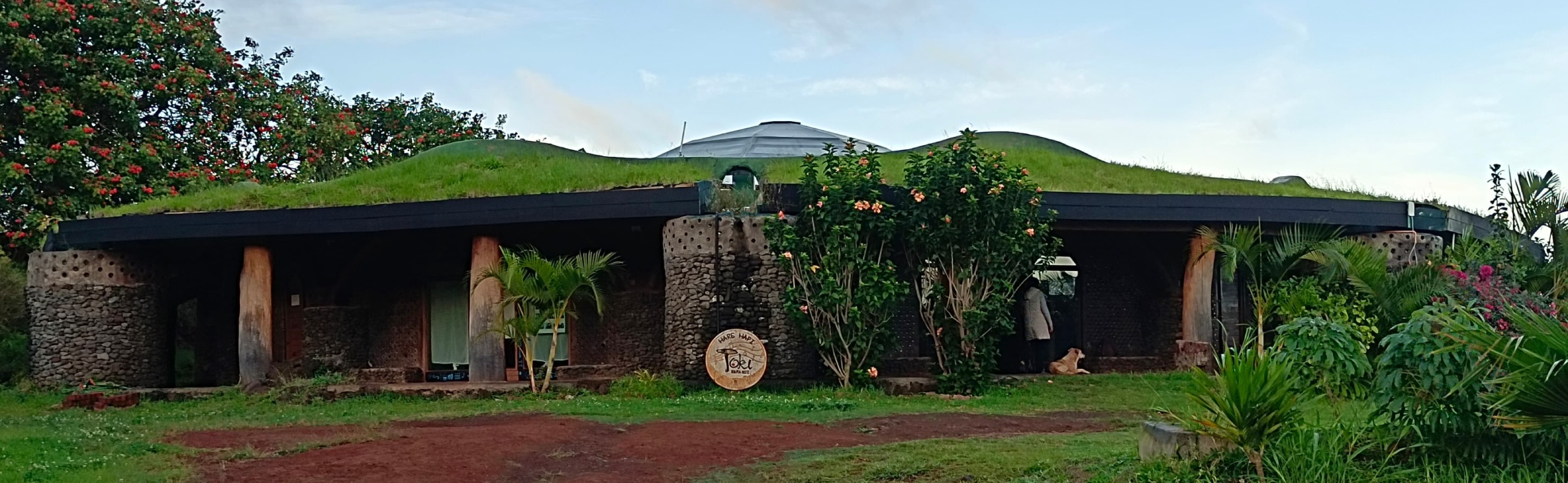
This fully self-sustainable building, constructed with recycled and repurposed materials, was designed by renowned architect Michael Reynolds and brought to life thanks to a crowdfunding effort, the support of Entel, the work of Desafío Levantemos Chile, and more than one thousand volunteers who contributed during the two years the project took to complete. The construction process was led by Enrique, a construction engineer.
Years later, as our school continued to grow, we recognized the need to build the Mārae, our gathering space and place for working with the community, which also serves as a concert hall
Over a decade after the creation of Toki NGO, we are proud to have developed high-impact initiatives for the community and to be one of the most influential civil society actors in the field of education.
Milestones
Founding members

MAHANI TEAVE WILLIAMS

ENRIQUE ICKA TEPIHE

CLAUDIA FERNÁNDEZ PAOA

JUAN BAUTISTA HAOA

JUAN PAKOMIO

HINEVA SCHMIDT

VAIROA IKA


